You Really Think You’re Special?


Originally published in Italian for Stratagemmi magazine. Link to the original article
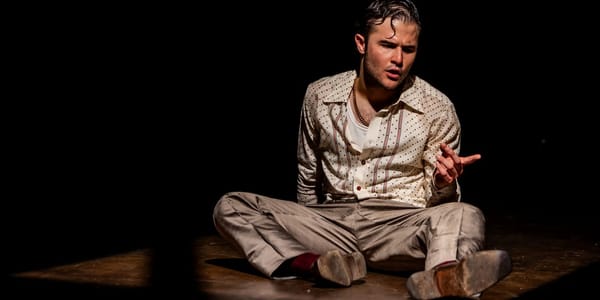
Writing a debut work is no small feat. For many emerging artists, the easiest path is the autobiographical one: starting from the self to explore the cracks of a generation, an era, a shared identity. Stupido Unicorno, the latest stop in Tobia Rossi’s creative journey, toys with that model: it imitates it, twists it, and finally turns it inside out. At its centre stands Igor (written by Rossi and performed by Umberto Petranca), a thirty-year-old gay actor who invites us to believe in his authenticity even as he confesses he is a fiction — a consciously crafted act of storytelling.
Igor uses the Milan Fringe as a test site for a “Netflix-style” series inspired by his life, hoping to sell it to a producer. The grassy clearing around the wooden stage at Cascinet of the Ortica district becomes an open-air editing suite. The story unfolds with the grammar of a storyboard: all cuts, close-ups, jump cuts, and flashbacks.
Onto this fragmented, cinematic structure, Rossi layers Igor’s personal tale. Fresh from a breakup, Igor is tricked by his mother into leaving Milan and returning to his hometown. There he meets Eros, a young student who ropes him into staging a living Nativity scene. Yet going home also means diving into memory: a fraught relationship with his father, his first uncertain steps onstage, his lifelong hunger for validation.
Rossi’s writing is restless and voracious, spinning between loneliness, ambition, and disillusionment with the artistic world. The result is a deliberately unfinished mosaic — a patchwork of feelings that overlap, collide, and then scatter, like in an Orson Welles long shot. The gaze remains wide, more suggestive than analytical. After all, Igor reminds us, this is just the teaser for his pilot: a quick, distracted glimpse, as fleeting as the binge-watching culture it mimics.
Two threads emerge from the tangle. The first is a return to one’s roots. Forced back to his village, Igor rediscovers in the Nativity play a collective ritual — a fragile but genuine sense of belonging. Here lies another possibility: not to stand out at all costs, but to find a place where one might simply fit. The second thread is the narcissistic, performative self. Ever since childhood, when he appeared on a popular TV show, Igor has chased applause as proof of existence. Beneath that glittering ambition hides a simpler desire: to be seen, desired, recognised — like a unicorn.
The ending hints at a change. Igor seems ready to let go of his individualism, choosing to stay and help with the Nativity scene. Moments later, he rides off through the audience on a scooter, helmet fastened, heading back to Milan for a meeting with the producer. The dream of turning his life into a screenplay is intact — just rebranded. The hunger to stand out hasn’t vanished; it has merely found a new disguise. Storytelling, after all, is the most marketable form of narcissism we have.
With Stupid Unicorn, Rossi and Petranca capture a society raised on the promise (and later the pressure) of being extraordinary. They ask, with empathy and irony: can we ever stop wanting to be special, or do we just want someone to give us a deal?