(DIS)Umanə: a Voice Beyond Consolation
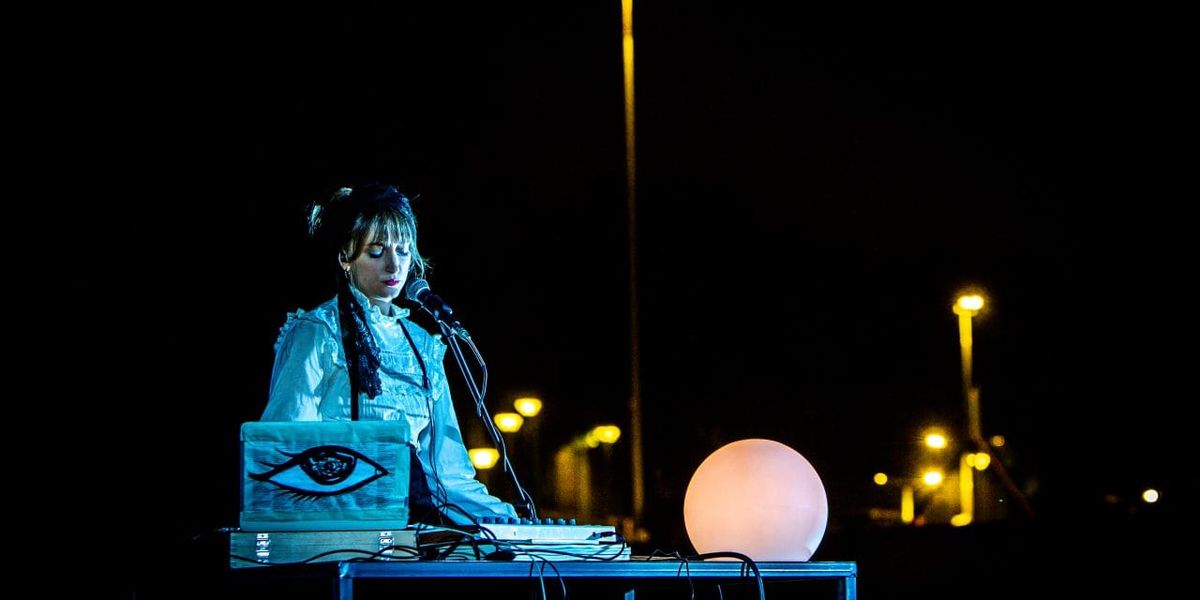
Originally published in Italian for Stratagemmi. A loop station, a bottle of alcohol, a stage scattered with crumpled sheets of paper. A single glance is enough to grasp the irreverent and disorienting charge of UMANƏ, a performance by Camilla Violante Scheller (aka Navëe) staged at Cascinet all’Ortica. The work rests on an essential, almost didactic scenic setup: standing behind the console, the artist — at once DJ, priestess, and lecturer at the podium — layers sounds, generates obsessive echoes, and inscribes in the audience’s mind an imaginary that is as acoustic as it is ideological. Through a hybrid language that interweaves prose, song, and technology, Navëe deconstructs the very notion of “humanity”: probing its etymological roots, dismantling its cultural assumptions, exposing its commonplaces. Once the idealised narrative of the human is shattered, the performance reveals its ambiguities, bringing to light a concrete, contradictory substance. The title itself written with the schwa is a declaration of intent: a rejection of the male/female binary and of the social norms that culture codifies, reproduces, and enforces. The process of “dehumanisation” enacted here operates first and foremost through the manipulation and deformation of the voice. Delays, saturations, and distortions bend sound to the limits of the possible, giving rise to a jagged soundscape made of orgasms, prayers, vocalisations, invocations, silences. The voice becomes by turns dark and mechanical, airy and sensitive, an intermittent signal of a “human” dismantled piece by piece, reduced to trace, echo, residue. Fragmented — and never banal — is also the thematic mesh that moves, without hierarchy, through flatulence, masturbation, post-orgasm depression, death, apathy. UMANƏ oscillates between lyrical surges and disturbing images, between poetic intensity and physiological concreteness, refusing any polished narrative in order to return a real body: vulnerable, at times indecent. Onto this fragility is grafted a sharp critique of performance culture. Navëe exposes the myth of self-affirmatin — what the sociologist Byung-Chul Han has termed the “society of positivity” — in which every failure is attributed to the individual and every form of suffering read as a lack of will. Within this system, the human wears itself out in the attempt to coincide with an unattainable ideal of efficiency. “I would like to carry out a revolutionary act, but I can’t. So I don’t disturb anyone, I masturbate,” the artist declares. The line whispered, harmonised, then relaunched with ferocious irony condenses one of the performance’s central nodes: the sense of inadequacy and impotence that grips humankind. This is not merely an individual fragility, but a structural condition: the human is ontologically unfinished, imperfect, incoherent. And yet, although the text raises a constellation of questions — from language to identity, from sexuality to violence — it does so without claiming to offer answers, let alone to trigger consolatory dynamics. Far from pointing to precise ways out, Navëe’s performance is instead a lucid, disenchanted exposure of contemporary unease: a confession that becomes release, an amplified resonance of ineluctable suffering. It is perhaps in this awareness—devoid of salvific footholds—that art’s most authentic function emerges: not to transform reality, but to make it traversable. Not to promise change, but to generate a catharsis born of recognising pain, of sharing it, of translating it into form.