Take a picture before I'm gone
Originally published in Italian for Stratagemmi. Click here for the original article.
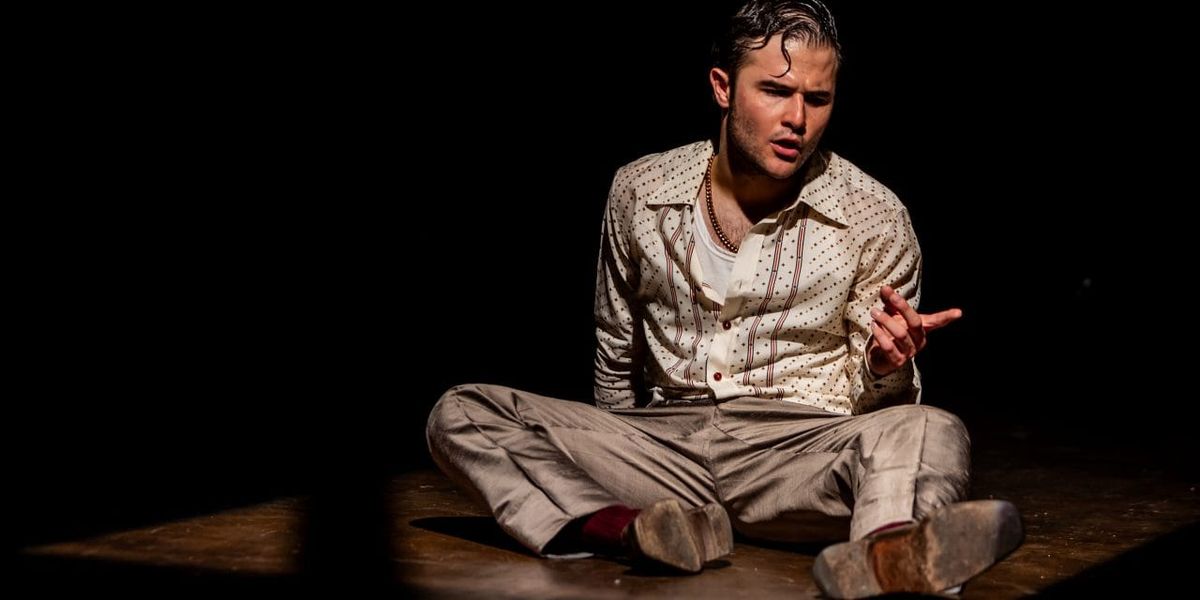
Unbuttoned shirt, white vest, corduroy trousers, a thin gold chain. The stage entrance of Crazy Bosnian Guy (the only character in A volo d’angelo, written and directed by Federica Cottini).immediately activates a vivid, almost postcard-like imaginary. It is the aesthetic of the Balkans in the 1990s, a temporal fault line marked by the post-socialist transition and geopolitical reconfiguration. In this figure are condensed the traits of a generation raised in precarity and in the art of getting by, quick with a joke and a touch of gel in the hair. Giving body to this histrionic fifty-year-old, at Spazio Polline in Villapizzone, is Michelangelo Canzi, a young actor born in 2000. The temporal short circuit — between the narrated age and the performer’s actual age, but also between memory and the present — constitutes one of the staging’s key compositional principles. The dramaturgical structure rejects any chronological linearity, opting instead for a score assembled from fragments. Once on stage, the nameless protagonist introduces himself as a tour guide in the city of Mostar and asks the audience to take his picture. From there, the narrative opens into a montage of memories, reflections, and inner visions: it takes us to the trenches of the Balkan war, when the narrating voice was nineteen and carried ammunition to the front; then into the post-war period, marked by emotional precarity, depression, and addiction; further back into childhood, when he dreamed of escaping a Yugoslavia already perceived as marginal. Finally, it ventures into an imagined future: with clarity and ironic tenderness, the man envisages the world after his own death and fantasises about the lives of those who will survive him: his wife, his children, his grandchildren. Within this discontinuous weave, the war is not reconstructed as a historical event but traversed as trauma, both individual and collective. It is a watershed that fractures and recomposes the boundaries of subjectivity. Crazy Bosnian Guy, an ordinary man miraculously spared, has lived first-hand a conflict built on ethnic and religious opposition, yet he dismantles from within the very idea of identity. “I am Muslim because in the Middle Ages they paid my great-grandfather to convert,” he says with bitter irony, exposing its contingent, accidental, historically induced nature. By extension, under the inexorable flow of History, the identity of places also becomes unstable. The protagonist is born in Tito’s Yugoslavia, passes through its disintegration, and finds himself in a new nation, more industrialised and more westernised. Places change their faces: they are destroyed, then rebuilt, repurposed, returned to new functions or configurations. Emblematic in this sense is the bridge of Mostar, destroyed in 1993 and rebuilt in 2004. It is from there that local boys dive “a volo d’angelo”: a gesture of stubbornness and courage, but also a local tradition that predates the conflict and survives it. Ultimately, A volo d’angelo is also (and perhaps above all) a reflection on the ambiguity of memory. Storytelling is an act of resistance, an attempt to wrest a removed history from oblivion. But it is also display, a narrative offered to the gaze of others, even put up for sale: “My pain is my business,” the guide tells the group of tourists who have come to hear his story. “Take a picture” is the first and last line of the text. On the surface, a gag, an entertainer’s gesture. But in its obsessive, subdued return, other meanings accrue: it is a request for attention, an anchor against fading and oblivion. And precisely within that request — ironic, fragile, disarmed — a quiet reversal takes place: the audience is no longer a mere spectator but becomes a witness. Responsibility no longer lies solely with the one who tells the story; it also concerns those who listen. What does it mean, today, to remain watching? And, above all, what do we choose to do with what we have seen?