Toronto makes more sense through theatre
Originally published for FermataSpettacolo.
Anyone arriving in Toronto understands it quickly: this city does not have a single identity so much as a system of coexistences. It is a place shaped by arrivals and renegotiated genealogies. Nearly half of its residents were born outside Canada; the rest descend from British colonisers, later waves of migration, and, in far smaller proportion and under a long history of marginalisation, Indigenous peoples. Toronto is multiculturalism par excellence.
That is why museums alone are not enough. The encyclopaedic sprawl of the ROM and the pictorial sweep of the AGO are certainly worthwhile stops. But if you really want to read Toronto, the city demands another threshold. Theatre, for instance.
It is worth saying this upfront: Mirvish productions can remain in the background. Not because they are irrelevant, quite the opposite. They represent the polished endpoint of North American entertainment: musicals and large-scale productions that, for the most part, arrive already packaged from the United States.
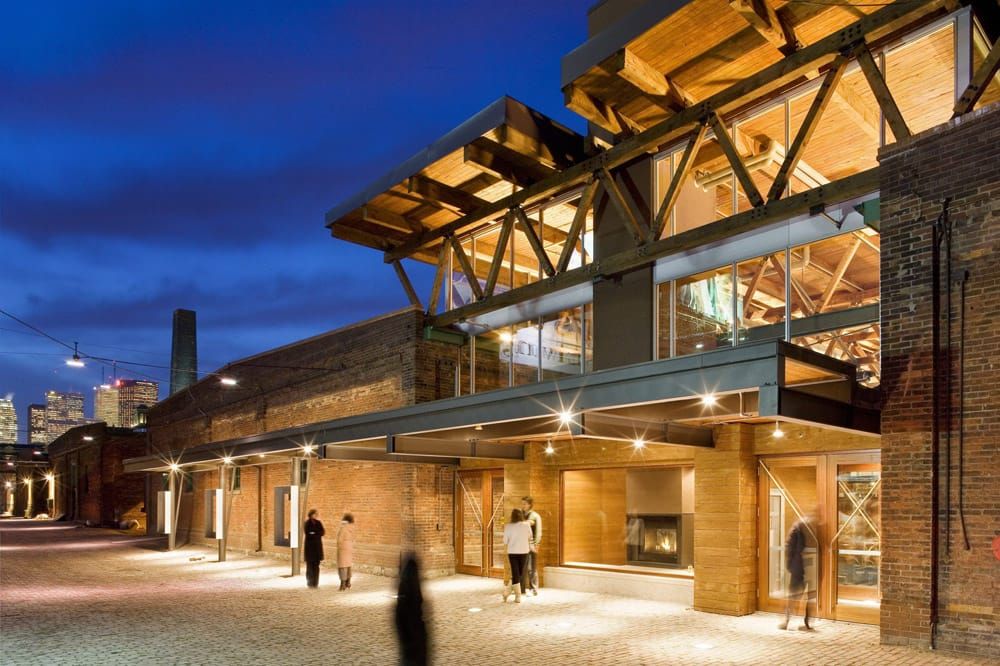
Instead, let us move closer to the more local identity of Toronto theatre. Soulpepper Theatre is one of the best places to begin. It sits in the Distillery District, a historic neighbourhood carved out of the nineteenth-century Gooderham & Worts distillery. Red brick, industrial memory, machinery displayed behind glass: within this setting, Soulpepper occupies the role of the city’s authoritative theatre, with rigorous, relatively conventional productions that still leave room for emerging voices in the Canadian scene.
Watching a Soulpepper production, one thing becomes immediately clear: Toronto theatre still gives primacy to the dramatic arc. To an Italian eye, used to forms of theatre that often understand themselves as critical or thematic exercises, the difference is striking. Toronto more often prefers to entertain before it persuades. But it would be a mistake to confuse that legibility with reassurance. Within structures that are often very solid, Toronto dramaturgy returns again and again to the same knots: fractured identities, diasporic memory, roots buried in neglect. In a city that makes plurality part of its official narrative, theatre seems mostly concerned with the cost of that plurality.
A second key point for understanding theatre in Toronto is explicitly political: what does “Canadian theatre” actually mean? For a country that has long perceived American cultural pressure as a concrete threat, the question is central. One need only recall that, in the post-war period, Canada established the Massey Commission with the stated aim of countering the cultural influence of the United States by strengthening national artistic institutions.
The Stratford Festival, about an hour and a half from Toronto by car, belongs fully to this ideological constellation. Founded in 1953, it remains the country’s best-known theatre festival and a pillar of Canada’s cultural self-representation. If you are in the city between spring and summer, the trip is worth making. Canadian Stage, too, embodies this historical and political tension, with its declared ambition to consolidate a national voice.
But it is when that composure begins to crack that the conversation becomes truly alive. Theatre Passe Muraille is an essential stop if you want to understand one strand of the city’s experimental work and its alternative history. Crow’s Theatre, meanwhile, engages with contemporary dramaturgy that remains complex without losing contact with its audience. But if there is one theatre that genuinely deserves the trip right now, it is Buddies in Bad Times Theatre.
Founded in 1979, Buddies has been one of the decisive institutions in the development of LGBTQ+ voices on the Canadian stage. But calling it simply a theatre already reduces it. At times a nightclub, at times a club, at times an open mic, Buddies is above all a social space and a communal apparatus. In Italy, we still often ask theatre to elevate us. Buddies offers to host us. Its productions, daring and not always fully resolved, capture the boldness of a scene that does not merely reflect the present but tries to get ahead of it.
And if one wanted to look at Toronto from afar, from the bedside table at home, I would choose two names. Two playwrights: Erin Shields and Anusree Roy. The first is known for reworking classical material, myths and foundational texts through a contemporary lens; the second for a theatre shaped by familial tension, social violence, and fractures between generations and languages. In different ways, both help clarify something essential: contemporary Canadian theatre, when it is truly working, does not simply celebrate plurality. It puts it under pressure.