Bacchae: Making a Glorious Mess
Originally published for FermataSpettacolo.
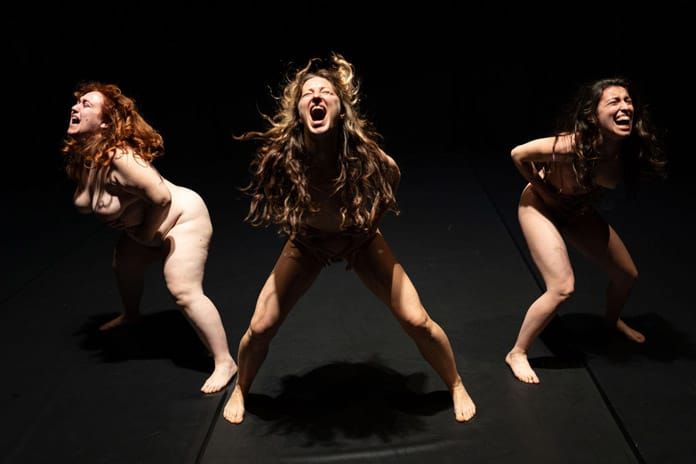
Some performances ask to be interpreted; others ask to be experienced. Santolini’s Bacchae seems to belong to a third category: work that asks to be accepted, however provocative and challenging it may be. Nudity, blasphemy, games, screams: the show oscillates between ritual and collapse, tenderness and violence. It is not immediately clear whether we are witnessing a performance, a ceremony, or a kind of collective regression.
“I’m not interested in provocation for its own sake,” Santolini says. “What I want is something that starts a reflection. Not about the show, but about who we are.”
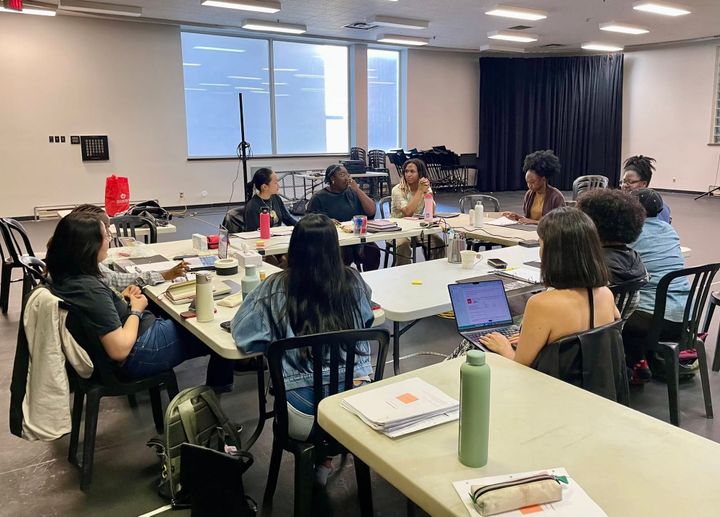
For director and choreographer Giulio Santolini, “making a glorious mess” means bringing into view what culture typically pushes aside: the biological, the obscene, the uncontrollable. The performance attempts to reopen the Dionysian as a space where these elements can emerge without needing justification. I met him in the rehearsal room ahead of the Milan debut at Teatro Fontana, where the company will stay for over a week, with most evenings already sold out.
This return to the body feels telling. After years in which contemporary theatre often leaned toward conceptual frameworks and political discursivity, Santolini’s work insists on embodiment, not as metaphor, but as material. “In Bacchae,” dramaturg Lorenza Guerrini explains, “the body becomes an unstable territory, oscillating between animal and human, sacred and grotesque.”
The performers themselves embody this instability. Ilaria Quaglia comes from a professional dance background; Mariangela Diana and Veronica Solari arrive instead from theatre. Santolini was interested in what might happen when these different corporeal languages collide. “What happens,” he asks, “when you bring bodies that are not trained in contemporary dance into a movement-based work? Bodies that don’t respond to the codes we’re used to?”
The creative process evolved accordingly. Santolini initially imagined a gradual approach to nudity, but rehearsals quickly dismantled that plan. The performers moved directly into exposure, skipping intermediate stages. What emerged, he suggests, was less representation than shared presence. “The show isn’t acted,” he says. “It’s lived. The material comes from their bodies, their histories. That’s what makes it true.” This emphasis on presence extends to the audience. The performance destabilises spectatorship, inviting viewers into an uneasy but participatory position. Santolini notes that reactions often diverge: some audience members struggle with the invented language spoken on stage, remaining anchored to rational interpretation, while others surrender to rhythm and enter what he describes as a Dionysian dynamic. “Everyone experiences a certain discomfort,” he says. “But it’s a gentle discomfort. It asks: what is your relationship to the body? To obscenity? To otherness?”
Guerrini, meanwhile, brings another layer into the conversation: ecology and transformation. The stage, she explains, is conceived as a landscape of waste, a world shaped by debris but also by possibility. “We imagined a tribe of women, daughters of a black sun, living in a world made of errors, mutations, and remnants”. She references Andri Snær Magnason’s On Time and Water, a book that suggests the dystopian future we fear is already our present: "plastic, technology, environmental transformation, all of it is already inside us".
In this sense, Santolin's Bacchae does not simply reinterpret Euripides. It attempts to reopen the Dionysian as a contemporary condition, one rooted in instability, transformation, and the possibility of beginning again. Understanding, in this context, may not be the goal. The Dionysian does not clarify. It destabilises. And perhaps that, today, is precisely its relevance.