ROHTKO (SIC!): Original vs Copy

Originally written in Italian for Fermata Spettacolo online magazine. Link to the original article
England, 1960s. A restorer named Tom Keating produces countless paintings in the style of the great masters, but hides within each what he calls “time bombs”: small clues that will one day reveal them as fakes.
What does this curious story have to do with Rohtko, the latest work by Łukasz Twarkowski? Quite a lot. Like Keating’s irreverent forgeries, Twarkowski’s production unsettles our understanding of art itself. Both interrogate the fragile pact between artist and audience, the value of authenticity and the ambiguous power of imitation. “Can a fake artwork still provoke real emotion?” the director asks in his notes.
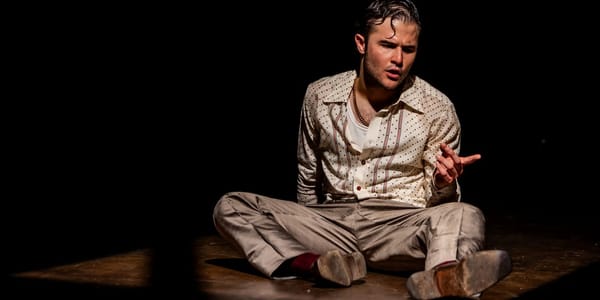
To explore this question, Twarkowski builds a complex dramaturgical structure around several interwoven narratives: Mark Rothko’s biography; the media scandal surrounding a forged painting sold to the De Sole couple; contemporary fascination with digital art; and a fictional audition process for a play about the abstract expressionist painter. This layered architecture allows the director to investigate ideas of duplication and reproduction.
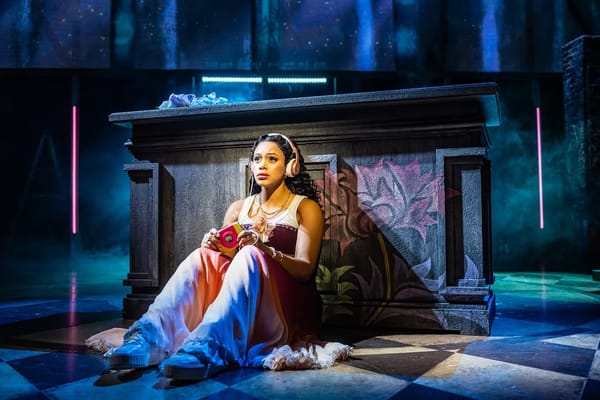
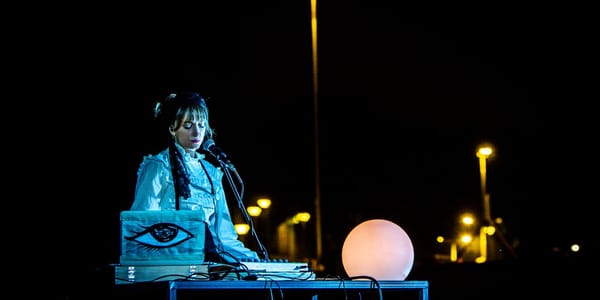
On stage, actors move through two identical Chinese restaurants, mirrored in every detail. Two cameramen film the action and project it live onto three large screens suspended above. The boundaries between cinema and theatre dissolve. The stage resembles a film set, complete with cranes, cables and monitors. The screens display a polished cinematic version of events, while the stage simultaneously exposes the machinery beneath: stagehands moving props in full view, performers waiting for cues, technicians whispering instructions.
This tension between illusion and exposure is central. Twarkowski does not simply recreate reality; he fragments it. Meta-theatrical gestures such as looking directly into the camera, exaggerated headset microphones and synchronised movements constantly remind us of the mediation at work. Like Keating’s “time bombs”, these micro-fractures force us to ask where the performance truly exists: on stage, on screen, or in our own gaze.
Rothko’s story is grounded in fact, as is the scandal that shook New York’s Knoedler Gallery, which sold numerous forged works at astronomical prices in the late 1990s and early 2000s. Yet as we examine Twarkowski’s production more closely, unsettling details emerge. The stagehands wear white overalls emblazoned with the word MUESUM, a deliberate misspelling of “museum”. The title itself contains another distortion: the displaced “h” turns Rothko into Rohtko. These apparent errors resonate strongly, especially considering that the performance opens with a “certificate of authenticity” assuring the audience that this is a true story about fake art.
Twarkowski ultimately stages a confrontation between two opposing notions of originality. In Western culture, as art historian Noah Charney notes, originality became sacrosanct the moment art entered the market and turned into a luxury commodity, its aesthetic value inseparable from its price. By contrast, in Chinese culture the concept of shanzhaiembraces imitation as transformation, treating copies not as inferior replicas but as creative reinterpretations.
In this perspective, the identity of the copy becomes more complex and even innovative, emerging from a new economic and aesthetic logic. In a world far beyond Walter Benjamin’s concept of mechanical reproduction, where art itself is increasingly immaterial, one is left with a final question: what is original, and what is fake?