& Juliet

Originally published for StageDoor. Click here to view the original article.
Three years after the final curtain fell on its first Toronto run, & Julietreturns to the city in a markedly different configuration. When the musical premiered here in 2022, it served as a pre-Broadway trial and its North American debut with a cast that transferred largely intact to New York shortly afterwards. Now returning for its first sit-down Canadian production, the show brings with it the West End staging and choreography that have fuelled its success in London and on Broadway, this time with a completely and proudly Canadian cast. The scale of anticipation has been unmistakable: the run was extended by eight weeks before opening, confirming that & Juliet returns to Toronto not to introduce itself but to meet an audience already eager to welcome it back.
At its core, & Juliet hinges on a single, appealing “What if?” What if Juliet did not die as a casualty of star-crossed fate, but instead chose to reclaim her life and pursue happiness on her own terms? Shakespeare’s tragedy is reframed as a story of second chances, with Juliet escaping Verona and setting off in search of a self-determined future. The premise aligns neatly with contemporary pop-feminist narratives, privileging resilience, choice, and self-authorship over romantic fatalism. This dramaturgical structure relies on a playful metatheatrical device: the rewriting of Romeo and Juliet is triggered by Anne Hathaway’s refusal to accept Shakespeare’s tragic ending, demanding instead that Juliet be granted another chance. Throughout the musical, Shakespeare and his wife repeatedly interrupt the action, disputing authorship and reshaping events in real time.
The ingenuity of the premise, however, is quickly burdened by an overworked plot. The story relies on a dense accumulation of twists, reversals, and rapid pivots that arrive only to be swiftly undone. Romeo’s return from the dead, for instance, serves little dramatic purpose once Juliet has clearly moved on, stripping the moment of any genuine conflict. The result is a sense of constant motion without sustained dramatic weight, where developments feel less motivated by character or theme than by immediate structural necessity.
Even so, the production remains theatrically effective thanks to several decisive strengths, first and foremost the score. Audiences come to & Juliet less for plot complexity than for the exhilaration of a high-energy pop concert framed as musical theatre. The plot functions primarily as connective tissue, binding together an extensive catalogue of pop hits written or produced by Swedish hit-maker Max Martin, including chart-topping anthems such as “Oops!… I Did It Again” (Britney Spears), “I Want It That Way” (Backstreet Boys), “Can’t Stop the Feeling!” (Justin Timberlake) and “Roar” (Katy Perry). Narrative logic bends to the jukebox format, with character arcs existing largely to usher in familiar songs and the pleasure of song recognition.
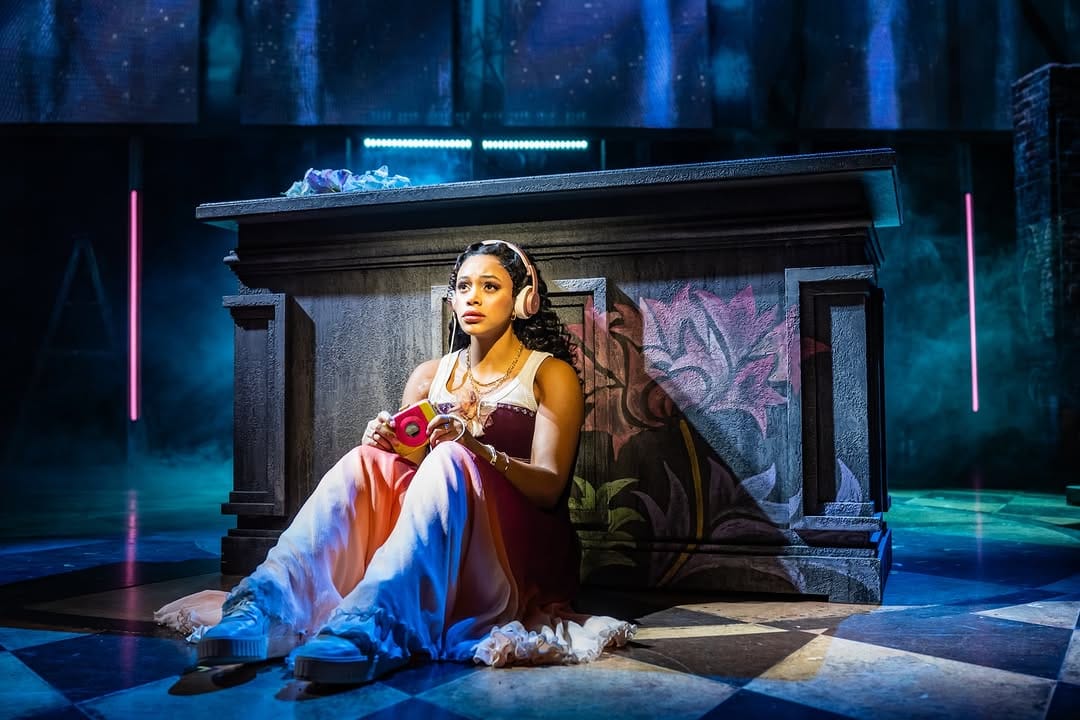
Among & Juliet’s strongest assets are Soutra Gilmour's scenic design, Howard Huson’s lighting and Paloma Young’s costume design, which collectively embrace a deliberate anachronism that fuses Shakespearean past and contemporary pop spectacle. A dynamic system of platforms, screens, and exposed lighting rigs allows the stage to shift fluidly from Verona’s tomb to a stylized Paris, complete with a gleaming Eiffel Tower and 20th-century nightclub imagery. History is not reconstructed but remixed. Elizabethan silhouettes brush up against pop-star costuming: ruffs, corsetry, sequins and saturated colour coexist without apology – choices that place the show squarely within a recent lineage of mainstream musicals, from Hamilton to Something Rotten! The design also foregrounds theatrical artifice: the backstage framework, imagined as that of Shakespeare’s own company, remains visible throughout, with lighting trusses and scenic mechanics left deliberately exposed.
Equally vital is the sheer drive of a talented and high-energy cast, whose commitment frequently compensates for the plot’s structural weaknesses. At the centre of the production, Vanessa Sears delivers a compelling Juliet. She pushes beyond the limits of the text, shaping a character who is forceful and impatient yet uncertain about what she truly wants. Through nuanced choices, Sears lends credibility and dimensionality to the role, allowing emotional contradictions to coexist. Vocally, she proves equally versatile, adapting convincingly to Juliet’s emotional states, from raw desperation in “…Baby One More Time” to a clear, commanding presence in “Roar”.
The production is further enlivened by its supporting performances, which open up smaller, secondary love stories that complicate the show’s romantic universe. Juliet’s steadfast nurse, Angelique, finds herself drawn back to Lance, a gruff but unexpectedly tender presence; their turn through “Teenage Dream” lands as a moment of easy pleasure, with Sarah Nairne and David Silvestri riding the song on relaxed timing, warmth, and an unforced chemistry that draws genuine laughter.
Along this trajectory, the metatheatrical frame offers another model of intimacy, as Shakespeare and Anne negotiate authorship as much as affection. Their relationship is a portrait of love beyond the “ever after” of marriage, shaped by distance, friction and loss. Julia McLellan’s poise and vocal control infuse Anne with resilience and maturity, while George Krissa makes a sharp impression even in the smaller role of the egomaniacal playwright, leaning into vanity and self-regard with easy precision.
The evening’s most incisive performance, however, belongs to David Jeffery. His Romeo is witty and sharply drawn, embracing caricature without slipping into incoherence. As a knowingly narcissistic drama queen, Jeffery skilfully breaks the fourth wall and commands the apron, making the role unexpectedly engaging and consistently entertaining.
One of the production’s most persuasive qualities, finally, lies in its ability to offer audiences a genuine sense of excitement and lightness, a return to the emotional intensity of adolescence that Shakespeare himself captures so vividly. The rush of first love, impulsive decision-making, and heightened feeling are filtered through contemporary concerns, touching on themes of gender identity, feminism, and post-romantic models of love. The most intriguing figure within this process of modernization is May, Juliet’s gender-nonconforming best friend, who follows her to Paris only to fall in love with their future husband. Matt Raffy brings vocal softness to the role; however, the characterization lacks a fully articulated inner trajectory, a quality that may deepen as the performance settles.
In the end, & Juliet knows exactly what kind of night it wants to offer. It may not be interested in rethinking Shakespeare or raising its narrative stakes and the underlying script and overall project are structurally flawed with intrinsic gaps that limit its coherence and depth. Yet, it does deliver joy, momentum and the unmistakable thrill of collective recognition. With its familiar pop anthems, high-energy performances and unapologetic sense of fun, the show succeeds in creating an evening that feels light, celebratory and emotionally immediate. For audiences looking to sing along, feel uplifted and leave the theatre smiling, & Julietoffers exactly that.
Alessandro Stracuzzi