Does the earth ache as roots dig into it?
Originally published in Italian for Fermata Spettacolo.
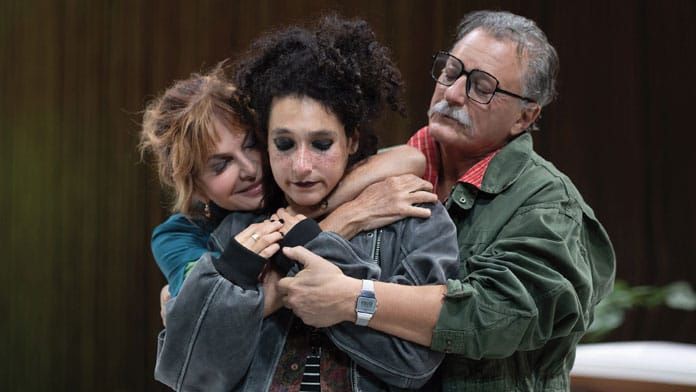
The set of Things I Know to Be True unfolds as an arboreal labyrinth. A revolving stage accommodates a large L-shaped kitchen counter, around which an armchair, a table, a mini-fridge, and a sofa are arranged. Yet it is the vegetal element that dominates the scene: plants of different sizes and species multiply in every corner, flooding the space with a vital yet unruly presence. The actors repeatedly shift and rearrange the pots, vainly attempting to impose order on a structure that remains irredeemably labyrinthine and vertiginous. Shrubs encircle the action, ensnare the characters, and evoke a forest that disorients and oppresses anyone who ventures into it.
Written by Australian playwright Andrew Bovell, Things I Know to Be True offers a sharp examination of the dysfunctions of what might be any family—an institution in which love and resentment coexist in a precarious equilibrium. In the Price household, the mother Fran is perpetually dissatisfied with her children’s choices, while the father Bob drifts on the margins, disoriented and unable to fully grasp what unfolds around him. Their children, meanwhile, are united by a shared suffering that each endures in isolation. The relationships are driven by constant psychological tension, sustained by a cruelly one-sided dialogue: parents imposing their worldview, children struggling to assert independence and individuality. Generational conflict thus emerges as the play’s central axis.
In this first Italian production by Teatro Stabile di Torino, the acting oscillates between biting humour and a lilting melancholy—a double-edged instrument that wounds and amuses, repels and draws in, engages and unsettles. Director Valerio Binasco, unrecognisable in the role of the awkward father Bob, drives the cast at a relentless pace, leaving almost no room for pause. Dialogues and monologues blur into a breathless rush, a compulsive outpouring of words deployed in a desperate attempt to escape paralysis and powerlessness. This unceasing momentum reinforces the sensation of a maze, in which the characters struggle to free themselves from roots that grip them tightly, slowly wearing them down.
The feverish rhythm supports a deliberately decentralised dramaturgical structure, composed of a series of autonomous tableaux, each exposing a specific form of toxicity in interpersonal relationships. Every scene erupts emotionally, yet never moves towards resolution, leaving both characters and audience suspended in a state of unresolved dissatisfaction. What accumulates instead is a continual disintegration of processes, a layering of tensions and fleeting releases, propelled by sharp lines that cut through the air like blades.
As in any familiar family stereotype, the pillar of the household is the Mother: an omnipresent, almost clairvoyant figure, capable of intuiting her children’s inner lives from a glance, a word, a sigh. The role is jagged and bittersweet, shaped above all by frustration and regret. Giuliana De Sio navigates Bovell’s writing with vertiginous precision, conveying the character’s abrasiveness while holding together the complexity of a love that is at once corrosive and protective — never justified, never condemned.
Around Fran gather the existential pains of the four young adults. The eldest daughter, Pip, seeks temporary escape in an extramarital affair, desperately searching for belonging and passion absent from her sterile marriage. Mark, the middle child, struggles to define his identity, only to collide with the one imposed upon him by his parents’ expectations. Ben, the perennial mummy’s boy, is consumed by an insatiable ambition that drives him towards both wealth and self-destruction.
The only figure who seems to elude this oppositional pattern is the youngest, Rosie—the unexpected daughter, born simply because there was no condom at hand. Nineteen years old, she idealises her family, perceiving it as flawless and refusing to detach herself from it. Though she should be finding her own path, she remains sealed inside a fragile glass bubble, resistant to growing up and eager to be sheltered in her innocence forever. Giordana Faggiano imbues Rosie with a quality that goes beyond mere immaturity, shaping her into a figure trapped in an almost pathological infantilism. Her delicate, fragile performance reveals a deeply rooted emotional dependency: every gesture and every faint vocal inflection suggests a desperate desire to remain protected, insulated from the tensions and disillusionments of the outside world.
The Price family has the potential to strike particularly sensitive chords with an Italian audience, for whom the family has long functioned as a powerful and often oppressive institution. It is no coincidence that, according to Eurostat data from 2022, the average age at which young Italians leave their parents’ home is thirty. Here, generational conflict is not merely a constant but a physiological necessity—a reaction to the mould that settles on the childhood bed. Yet the ruthless, egocentric hysteria Bovell assigns to each character ultimately creates a distance between stage and audience, inhibiting empathy. This emotional barrier compels spectators towards a critical, detached gaze, making it impossible to adopt a single, unequivocal position. Choosing a side reveals less about objective values than about one’s own personal history.