When you are silenced: '88 Frequenze'
Originally published in Italian for Fermata Spettacolo. Link to the original.
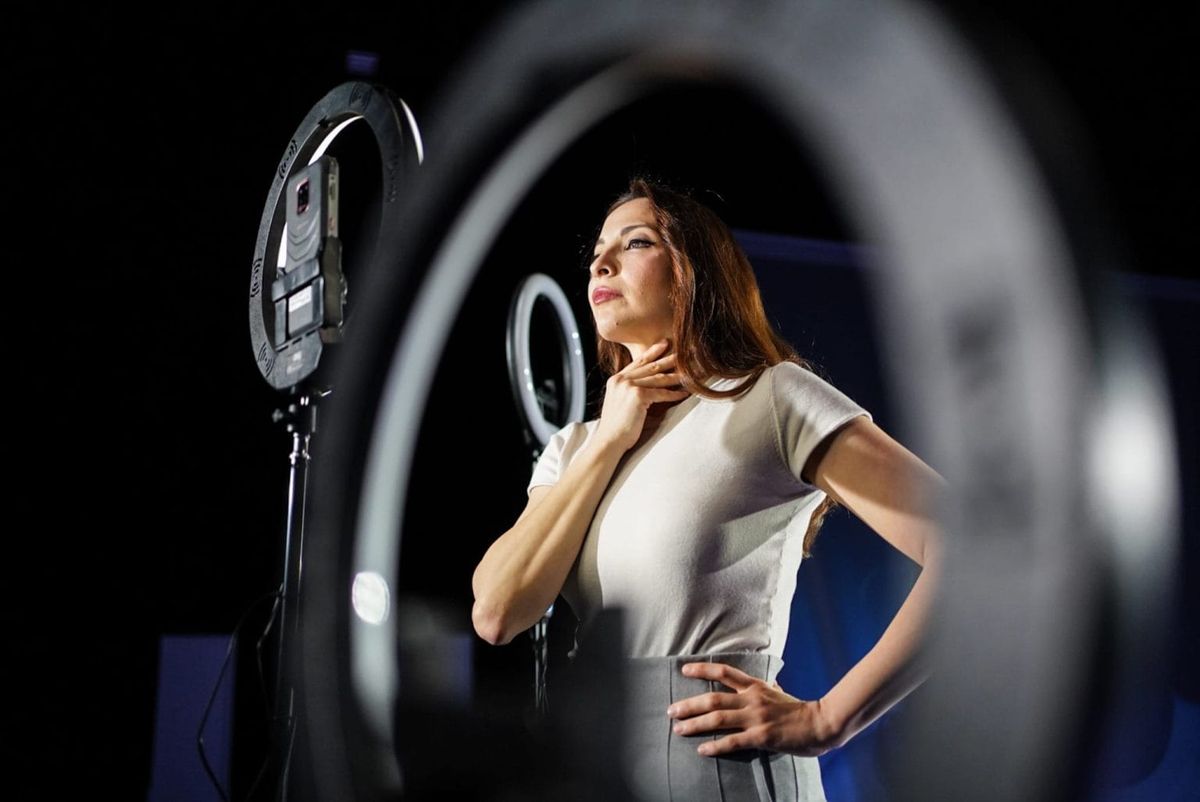
Seated at the centre of a ring-light diaphragm, those familiar tools of the self-tape auditions so loathed by performers, an actress (Antonella Carone) watches her own self-tape on a loop. Behind her, a long white cloth spills beyond the limits of verticality, extending towards the audience and transforming from a cinematic screen into a carpet: the stage on which the plea will unfold.
Recognition and identity: these are the two kaleidoscopic themes around which Eliana Rotella’s dramaturgical work 88 Frequencies is constructed, staged by Giulia Sangiorgio for the collectives Corpora/UNO&Trio. By immersing itself in the complex biographical story of Hedy Lamarr — glamour icon of early twentieth-century Hollywood — the performance reflects on gender and power dynamics within a patriarchal society.
Two trajectories guide the narrative: on the one hand, the artistic career of the Hollywood actress; on the other, her lesser-known yet perhaps more significant scientific contribution. Eager to take part in the fight against Nazism, the Austrian-born performer drew on her engineering knowledge to develop a radio-frequency model, hence the title of the show, for the encoding of information. The invention was epoch-making and laid the foundations for modern technologies such as GPS, Bluetooth, and Wi-Fi. Yet Lamarr’s contribution was ignored, and authorship of the project was never attributed to her. The media erasure of women’s achievements, after all, remains a recurring practice in the still-dominant rich-MEN’s world.
For the staging, the artists choose to traverse Lamarr’s story without superimposing their own biographical selves onto that of the film star. At the very beginning of the performance, Antonella Carone makes it clear that there will be no attempt at impersonation: Lamarr will be discussed, but not embodied; her life will be traced through a third-person commentary, allowing the portrait to speak for itself. The resulting monologue is a plea of striking clarity, lucidly exposing the systemic nature of the injustices the actress was forced to confront.
The rhythm of the writing does not follow a conventional narrative arc. Rather, it resembles an irregular heartbeat, alternating analytical moments with explosive ones, and others marked by discouragement. This fragmentation is also rendered visually through live projections onto the backdrop. The camera? A simple smartphone, constantly moved from one support to another. It perhaps symbolises the external gaze, partial and reductive, that male gaze symptomatic of a society in which gender equality remains unfinished. Only the audience in the theatre can see beyond the filmed moments, observing the actress through her hesitations, her discouragements, her moments of surrender.
Yet emotion never overwhelms the logical coherence of the indictment, nor does it dilute the forcefully political claim at its core. “Why her? Why me?” the actress asks on stage. Faced with ostracism, belittlement, and prejudice, Lamarr can do little: the individual cannot overturn, from one day to the next, the ravenous hierarchical structure in which they are embedded. What she can do is stubbornly carry on her struggle, ignore, smile — stretching the muscles of her mouth until her face threatens to split — and move forward. It is a powerful image of resilience rooted in inner firmness, in an ongoing negotiation with reality and a delicate balancing act amid injustice.
The central knot the performance brings to the surface is the most insidious form of abuse: silencing. It is perhaps no coincidence that one of the most recent popular feminist manifestos is titled Stay Quiet (Murga, 2021). The intimidation of silence diminishes, marginalises, and ultimately erases the voices that challenge the status quo. Once pushed into the shadows, their struggle cannot even begin: by then, they no longer exist.