“Throw Me a Rose”
Originally published for Stratagemmi.
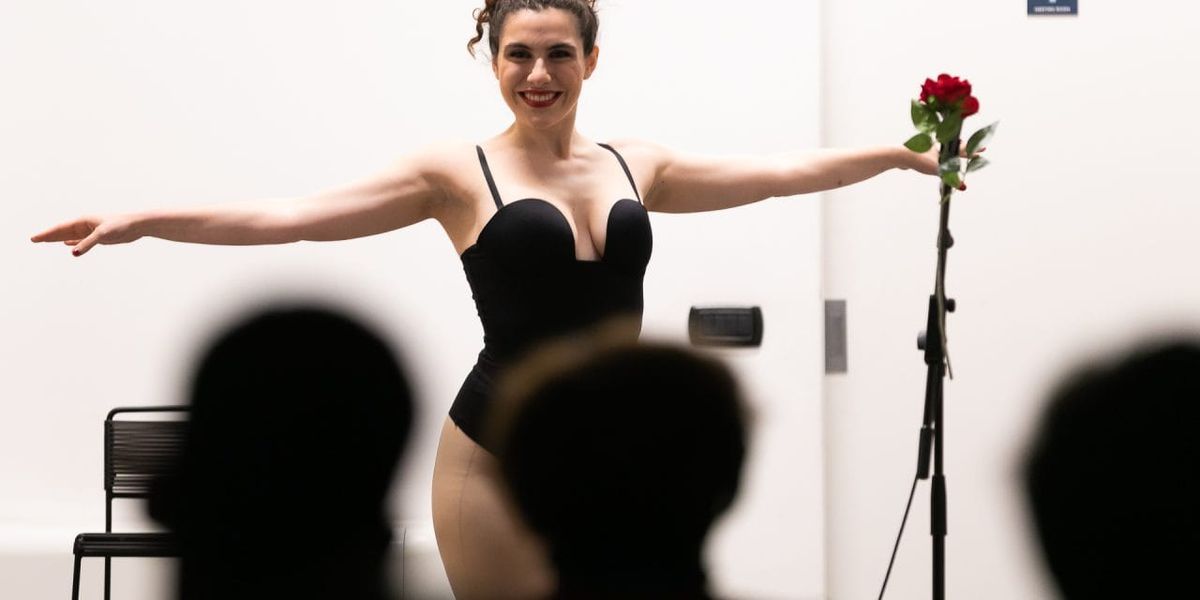
On the occasion of FringeMi 2023, the bare walls of the Materia co-working space are transformed into the stage for a beauty contest. Playing one of the contestants, actress Lucia Raffaella Mariani enters on tiptoe. She fixes the audience with an insistent gaze; a forced, pearly-white smile splits her red-lined lips, while a tight corset cinches her body. The timer starts. She has one hour to make herself loved by the judges-spectators just as she is.
Born in 1999, the actress presents her first piece of dramaturgy. Using the first person and drawing on her own personal experience, Lucia lays bare the tensions and obsessions of her everyday life. She confesses her anxiety about being liked, her dependence on approval, her thirst for validation. It is a competition of appearances in which, needless to say, the entire female gender is implicated. What takes shape is a feminist ode that exposes the dramas of being a woman today.
What emerges is the image of a society that constantly demands women reshape themselves according to the male gaze, that male gaze theorised by film critic Laura Mulvey, capable of dispensing love and guaranteeing validation. Mariani admits she is a victim of this conditioning, yet she cannot escape it. To feel fulfilled, she must be irresistible. And so she raids the beauty aisles of pharmacies, ‘the god of beauty is an inclusive god, money in your pocket is enough’, monitors her weight on the scales, and wears flesh-coloured underwear to conceal cellulite.
The density, including the political weight, of the themes explored, which involve us all, is conveyed through a hybrid form that blends stand-up comedy with song, tragic monologue with slam poetry. From the constant shift between a frivolously conversational tone and the sudden lyricism of the verse passages arises an emotional vertigo that leaves no one untouched. In her obsessive pursuit of perfection, Mariani longs to be a Marilyn Monroe, even at the cost of entering the darkness that led the cinema icon to suicide. Yet however hard she tries, she is not. The president she serenades with Happy Birthday first takes her to bed and then fails to renew her contract. She wants to be Marilyn and instead turns out to be a Sweet Charity. Like Bob Fosse’s character, she is endlessly searching for reassurance and solidity in the affection of others.
As we are gradually led into the uncomfortable condition Mariani experiences every day, her showgirl mask slowly dissolves into glitter dust. In the end, only anger and frustration remain. Her body is strained, exhausted, surrendered. And after exposing herself for what she is, in all her contradictions, the actress asks for one final, sincere gesture of affection. At the feet of their seats, spectators find roses, free to choose whether or not to throw them at the performer. What appears to be a delicate gesture thus becomes a violent one, yet another contradictory declaration of love that crashes down on her, once again, from the outside.