“Talk to Me Like the Rain”: the disorder of solitude
Originally published for Fermata Spettacolo.
Wednesday 18 October, 10:15 pm. The performance has ended, yet before leaving the auditorium the audience is invited to cross a stage strewn with objects: records, vinyls, chairs, bedside tables, wooden planks, a rocking horse, a wicker basket. A landfill of memories which, as the signs placed at either end of the stage announce, constitutes the “Museum of Collected Solitudes”.
Between 18 October and 5 November, Sala Tre at the Franco Parenti, transformed into a theatre in the round, hosts Talk to Me Like the Rain, a suite of five one-act plays by Tennessee Williams, four of them presented in Italy for the first time in Masolino D’Amico’s translation. From repression to aggression, from self-sabotage to shared solitude, these texts seem driven less by an interest in action, in what happens, than by a deep curiosity about the relational dynamics between the individuals who inhabit them.
The production’s choice to adopt a central staging system further multiplies the audience’s interpretative possibilities, allowing for different, unique, and unrepeatable viewpoints while encouraging an immersion that is not only emotional but above all physical. Guided through the characters’ fragilities, spectators observe under a magnifying glass a mal de vivre that is both cause and effect of the dysfunctional relationships on display.
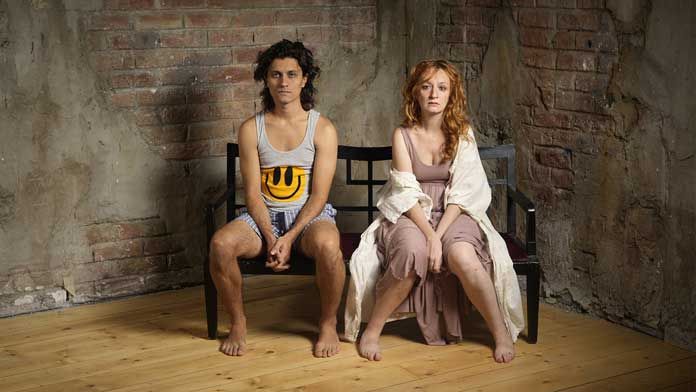
At the centre of the space, the actors Valentina Picello and Francesco Sferrazza Papa drift in an ocean of objects scattered across the stage, repositioning them each time to sketch the contours of the story being told. With every new scene, they must navigate constantly shifting rhythms, ages, and registers. First they play two children, then a couple in their forties on the brink of separation, then a factory worker and his wife, a mother and a son, and finally two spouses emotionally bankrupt. It is a demanding acting challenge, resolved through an archetypal style of performance rich in uncontrolled emotionality, even if at times it risks repeating itself.
Director Andrea Piazza, born in 1995, identifies human solitude as the common thread running through these one-act plays. Unable to communicate with one another, all the characters speak but do not listen, lose themselves in their own narratives, appear alienated within their pain, and remain indifferent to that of the other. Particularly striking, then, is Piazza’s decision to stage the incommunicability of one couple by doubling and mirroring on stage the bedroom in which the action unfolds. Separated by a precarious wall of wooden planks placed at the centre of the space, the actors speak with their backs turned to each other, wander within their own enclosures, and divide the audience into two entirely opposing factions.
From the music to the lighting design, especially poetic and delicate and also created by the young director, everything appears carefully aligned with the choice to pursue a vertical, concentrated exploration of solitude. And yet it is precisely this theme that risks appearing generic or abstract, perhaps not strong enough to contain the dizzying range of stimuli offered by the selected texts. As a result, the performance is enjoyable but only partially engaging, a refined presentation that leaves the audience slightly too detached. This, however, is part of the gamble, to a certain extent a successful one, of binding together under a single dramaturgical trait texts originally conceived as stand-alone works.