Narration and Meta-narration in 'The Trilogy of the City of K.'
Originally published in Italian for Fermata Spettacolo.
‘The space of the performance, in fact, does not exist. Its physical dimension resides solely in the objects that appear on stage.’ Thus, in 2002, Luca Ronconi described his work on What Matisse Knew in a conversation with Aldo Viganò. Then director of the Piccolo Teatro, Ronconi was already known for his inclination to bring to the stage texts originally conceived for reading, but Matisse was a particular case: the childhood of the now elderly protagonist was narrated through the filter of memory, producing an incomplete, unstable, faltering reconstruction of the past. The theme of narrative partiality and the fragmentation of information also emerges with striking clarity in The Trilogy of the City of K., the new production by Piccolo Teatro di Milano, on stage until 21 December at Teatro Studio Melato.
Agota Kristof’s novel, which serves as the starting point for Chiara Lagani’s dramaturgy, closely follows the diverging fates of Lucas and Claus, twins separated as children at the outbreak of the Second World War. The city of K. is an infernal place where morality is constantly betrayed, where oppression and abuse prevail. The harsh and unsettling story, encompassing complex issues such as war, violence, and survival, unfolds like a puzzle of events, names, and details: a labyrinth of information through which the spectator must navigate in order to actively reconstruct a coherent image of the narrative.
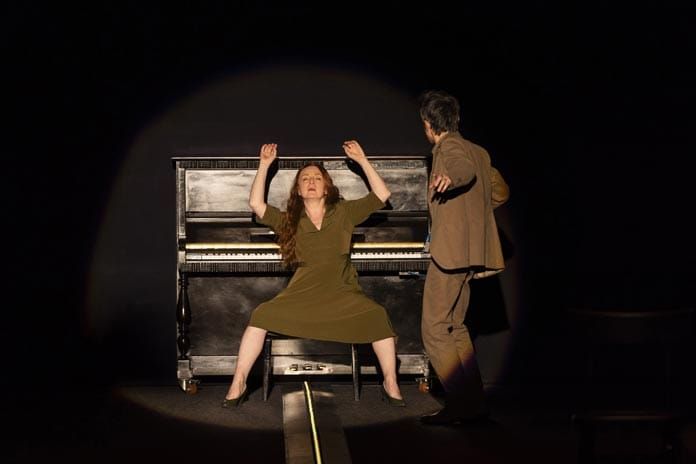
Two thematic lenses seem to emerge in this stage translation of the novel. On the one hand, Luigi De Angelis’s direction is dominated by the concept of the limen, the threshold or boundary. From the very beginning of the performance, and for almost its entire duration, a line of light divides the stage perfectly in two. It represents the border between the city of K. and the rest of the world, between territories at war and lands at peace. At the same time, it functions as a symbol of the parallel paths the two twins are forced to follow.
On the other hand, Lagani’s drama presents itself as a rediscovery of the possibilities and potential of narration itself. With stage action reduced to a minimum, the unfolding of the story occurs largely through storytelling. In the first part of the trilogy, the characters and locations evoked by Ágota Kristóf’s reconstruction, played by Federica Fracassi, are shown to the audience solely through static video sequences projected onto rectangular screens suspended in mid-air. Far from being exploited for its illusory power, the filmic image ultimately reveals the fictional nature of the performance itself. Close-ups of the actors are set against artificial, neutral backdrops and juxtaposed with real, natural environments such as trees, flowers, streams, and animals. In the second and third acts, by contrast, it is the actors’ bodies themselves that become the medium of narration. Their acting is estranged, their actions limited, and they systematically articulate stage directions aloud.
An experiment in endurance and the dilation of time, the performance immerses the audience in an unusual dimension that produces a sense of alienation in the face of suffering. Particularly emblematic is the image that appears on stage at the beginning of the second act. A gigantic humanoid statue slowly and inexorably rises from a trapdoor. It is a deformed body, with dislocated shoulders, curled in upon itself. It is Matias, nothing more than a child, nothing more than the formless product of the claustrophobic society described in the text.