Erectus – Pithecanthropus
Originally published in Italian for Stratagemmi.
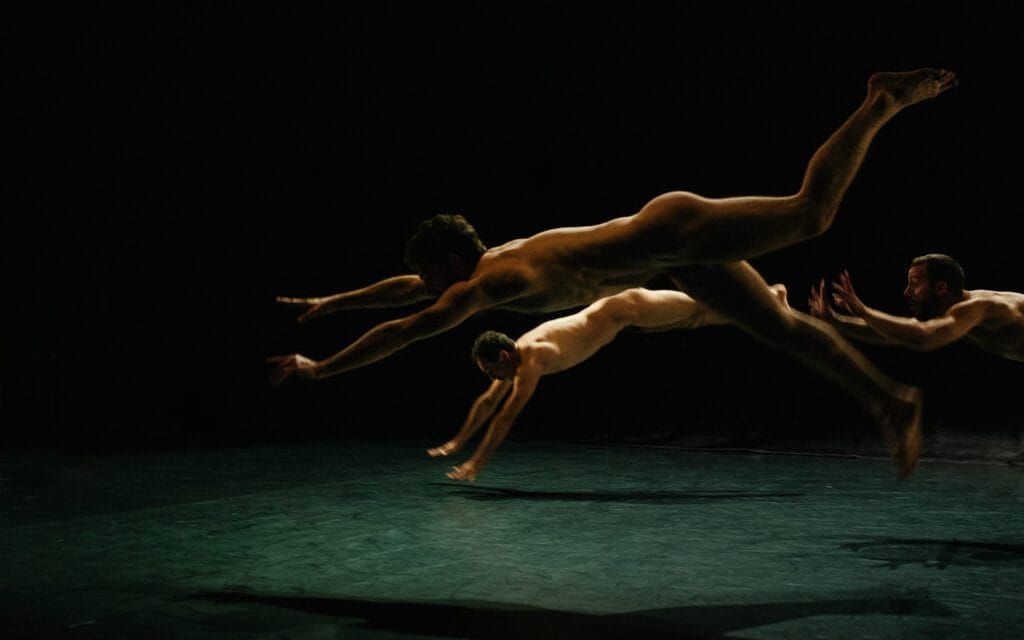
An empty stage, stripped even of its wings. In absolute silence, a dancer crouched on the ground and completely naked moves, almost imperceptibly, from the edge of the stage towards its centre. Observed closely, his body scarcely appears human. It rather resembles an amorphous cell or a small insect. At a certain point, however, he loses his precarious balance, falls, and curls into a foetal position. He then attempts to recompose himself. Hands planted on the floor, he pushes upwards, grows, evolves, and finally stands upright. He has become a man.
A central work within a trilogy developed over three years, from 2017 to 2019, and founded on the attempt to translate music into gesture, Erectus is an enchanting, elegant, and delicate performance. At the core of the work, choreographers Abbondanza and Bertoni place Charles Mingus’s album Pithecanthropus erectus, a composition that anticipated free jazz. Just as this musical current conceptualises a search for extreme improvisational freedom, detached from traditional aesthetics and rigid pre-established structures, so too the performance is characterised by a plurality of physical codes that are juxtaposed, superimposed, and freely layered.
Four dancers traverse the stage space, exposed to the audience in their raw state, stripped of clothing as well as of tradition. Amid occasional rond de jambe en l’air, sudden grand battements, and even a brief passage en pointe, the grammar of classical technique is dismantled and reconstructed, making room for the energetic and vital essence of the bodies on stage.
Nudity, which persists throughout the performance and might at first glance appear to be its defining element, quickly recedes into the background. The audience grows accustomed to it, accepting it as a simple and natural human condition. What instead asserts itself is the tight interpenetration with the music. Melody and movement appear as the continuation of one another, engaged in constant mutual stimulation. The body appropriates rhythm, scales, and accents, transforming them into physical instincts. The dancers carry the performance forward tirelessly, displaying an almost animal strength that captivates and enchants the audience.
Far removed from narrative or emotional urgency, the body thus becomes the site of investigation for an entirely concrete concept, virility. As the performance’s guiding thread, this research nonetheless aims to reclaim a sense of the masculine far removed from the ideological encrustations the term carries in contemporary society. Masculinity also becomes delicacy of gesture, harmonic strength, an extended and elongated body, fluid and sensual movement that at times provocatively nods towards the canonical feminine.
The choreographic dramaturgy is woven with impeccable clarity, legible despite its fragmentation and stratification. Solo moments intertwine seamlessly with passages of absolute synchrony. Entrances and exits occur suddenly and yet so fluidly that the spectator barely notices them. Equally fluid is the constant sliding from moments of unrestrained release to sections of restitution and renewed anchoring to the music. The themes explored are multiple, ranging from phases of Darwinian evolution, including imitations of the hopping, four-limbed locomotion of apes, to references to modernity, with gestures so mechanical they recall Chaplin in Modern Times. A plurality of genres and gestural languages is combined spontaneously. Reworkings and appropriations of jazz dance steps, gospel choruses, and tap dance also emerge. It is within this citational play, a kind of ironic apologia of humanity, that clear references appear to works such as Michelangelo’s Pietà, Matisse’s Dance, and Velázquez’s Christ.
What unfolds, then, is an exploration of metamedial and metastylistic references aimed at exposing a multifaceted humanity. Particularly telling is the assimilation between the masculine and the animal achieved through the use of projection. On a sheet placed at the back of the stage and agitated by a fan, a series of black-and-white images is shown between each track of Mingus’s album. They are blurred and difficult to read precisely because of the constant movement of the fabric. The image becomes fully legible only at the end of the performance. At that moment, the veil falls and the figure sharpens against the bare wall. It is a powerful black horse, a symbol in dream language of sexual drive, energetic, strong, virile, with an elongated, tense neck and bloodshot eyes.
And just as the falling of the veil renders the image readable in its full essence, so too, throughout the performance, humanity itself is revealed. Erectus guides us on a journey through the possibilities of what the masculine can mean, beyond social superstructures and cultural accretions.
Alessandro Stracuzzi