CROSSROADS #INHABITINGTHEWORLD
Originally published in Italian for Stratagemmi.
An empty stage. Tribal music. Four dancers take turns inhabiting the space, giving rise to four performances that are strikingly different from one another.
#1 Static pseudo-figurative drawings are projected onto the back wall while performer Matteo Sedda positions himself between the projector’s light and the surface, crystallising his body into a sequence of poses. His shadow becomes an integral part of the image on the wall, and the graphic line of the projected drawing freezes across his body. Cut.
#2 Kumar scatters thin sheets of coloured paper across the stage. They almost recall Amazing Grace by Nari Ward. With fluid gestures that are constantly off-balance, often developed close to the floor, the dancer moves through the space marked by the brightly coloured sheets on the ground. He then gathers some of them and uses them to cover his face, as if assembling a Día de los Muertos mask. Cut.
#3 Wolowiec’s body is in a state of constant precarious balance. Although her feet are firmly planted on the ground, she shifts her weight back and forth. She wavers, at times she falls. Yet she is resilient. She clings to the bodies of others, struggles against herself, and rises again and again. Cut.
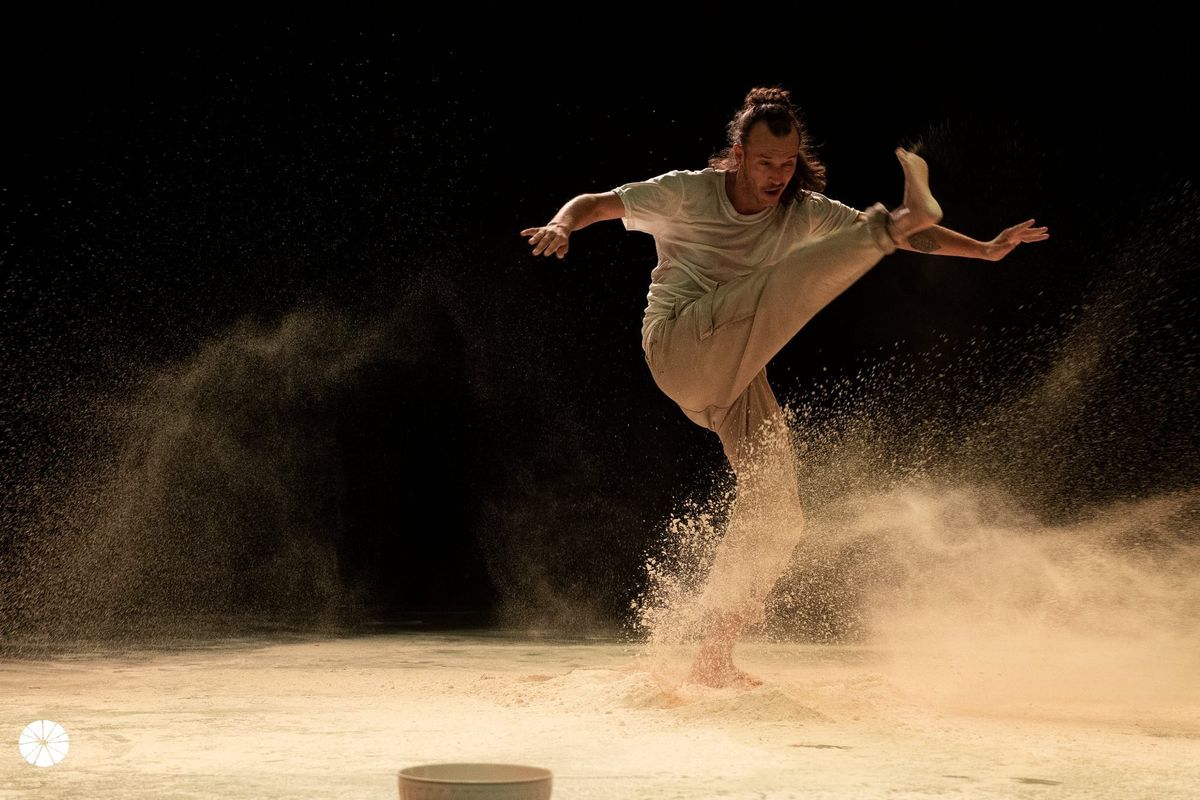
#4 Finally, though it is not the end, Sly spreads fine sand across the stage space, surrendering to a tribal dance. He hops on one foot, as in the ritual dances of a heterotopic imaginary Africa.
The four dancer-authors of Crossroads developed their performances during periods of residence abroad as part of the MIC Boarding Pass project. Accompanied by local artists from the most varied disciplines, they were given the opportunity to merge with their places of arrival and to engage with local practices, perspectives, and aesthetic and ritual conventions. Sedda worked in Calcutta with a visual artist; Kumar with a Mexican composer; Wolowiec with a video-maker in Lebanon; Sly with a Senegalese musician.
Experiences in such distant corners of the world could only generate a heterogeneous and deliberately disjointed performance. It is no coincidence that the subtitle of the work is Inhabiting the World. The diversity of gestural palettes adopted by the performers, who are also the choreographers, conveys the plural variety of peoples and cultures across the globe, almost suggesting a struggle against ideological absolutism in favour of the relativity of viewpoints. What unites the four solos, by contrast, seems to be the desire to convey the impressions and emotions the dancers experienced first-hand in the places they travelled through, including disturbance and frustration. Amplifying this is a highly coherent musical horizon, dominated by percussions that echo the beat of the human heart and the roar of vital energy.
The performance’s metamedial quality is most clearly grasped in Sedda’s extreme and demystifying proposal. Although it appears to be the most controversial, his contribution is also the most compelling and densely meaningful. Beyond opening the performance, as already described, he is also entrusted with its conclusion. For more than ten minutes, lying on a transparent plastic mat, he violently and at the same time sensually crushes a series of fruits. Throughout, he fixes the audience with an intense, insistent, provocative gaze, almost erotic, recalling Manet’s Olympia. He teases the spectators, challenges them. Repeatedly, he draws out an enormous sharp knife, whose presence inevitably chills the audience. At the end of the performance, his body is entirely covered in a blood-red liquid that disturbs and unsettles. His work fascinates, astonishes, disorients, and undoubtedly captures attention.
The aggression Sedda puts on display evokes anxieties of abuse, mistreatment, and domination. It is a violence that accepts nothing beyond itself, and before which the audience remains stunned. Vocal expressions of dissent are not absent. At the second performance, a spectator began shouting abuse at the artist. Should the provocation therefore be considered successful? And this leads one to ask, upon leaving the theatre, what remains beyond the scandal. Is unsettling the spectator a sufficient objective?
Alessandro Stracuzzi