Chernobyl: long live the Soviet Union
Originally written for Fermata Spettacolo.
It is difficult to summarise in a few lines the colossal and multifaceted work by Bellini and Sinisi, staged at Teatro Fontana in Milan for most of last November. Chernobyl is a complex, layered production, capable of enticing the audience with inventions that are as astonishing as they are sudden.
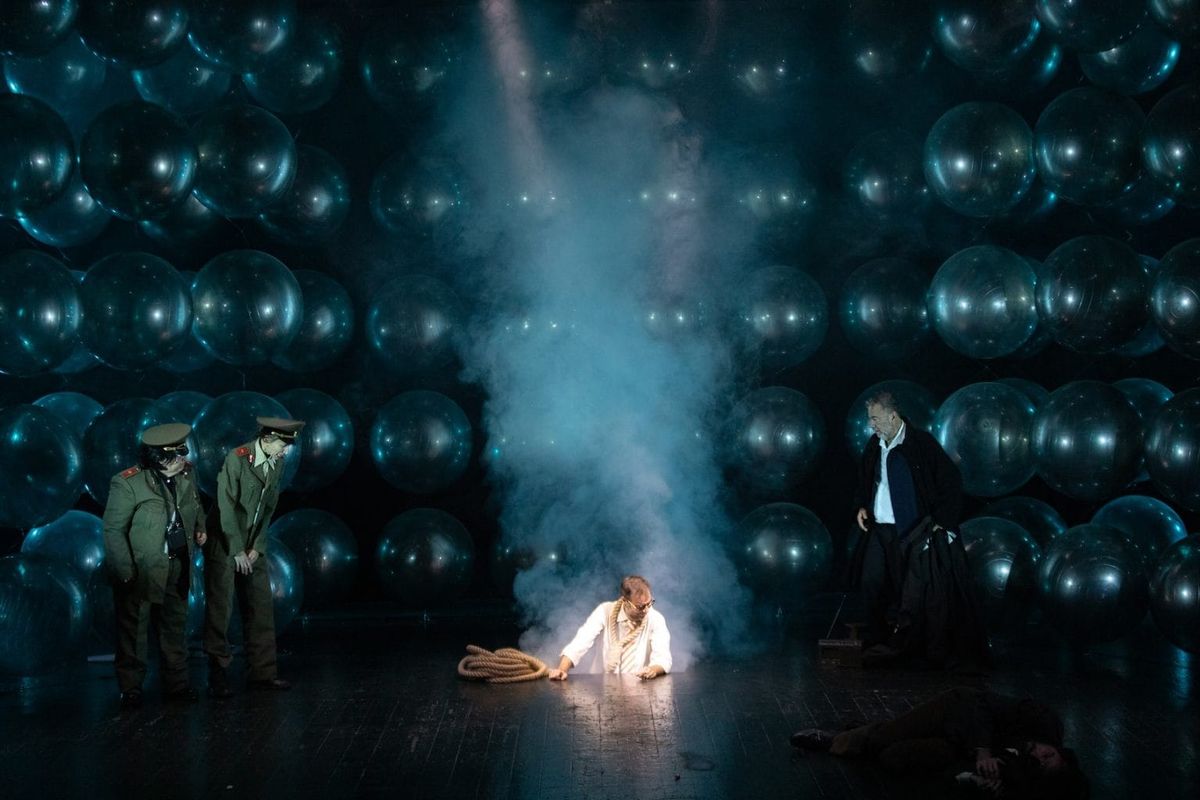
A single blink would be enough to miss the scenic transition that transforms the bare opening setting into the cold lair in which the narrative takes shape. The black drapes that had sculpted the room fall away, revealing behind them what appears to be the interior of a nuclear reactor. The image is striking: rows of atoms, juxtaposed and overlapping in a semicircle, stand as the sole witnesses to the inquiry that is about to unfold. On the prosecution side stands the Party, with a capital P. For the defence, Viktor Bryukhanov, thirty-six years old, director of the Chernobyl nuclear power plant at the time of that distant yet indelible April 1986. The prosecution’s objective is clear: to bury every uncomfortable and awkward detail of what occurred. Bryukhanov will serve as the scapegoat, a Malaussène before the fact.
Within the expanded temporal frame of the play, the disaster happened, is happening, and has already happened.
It is an oppressive, Beckettian presence, constantly invoked yet slow to arrive. It emerges above all through testimonies from different identities and perspectives, those of doctors, physicists, soldiers, and civilians. In an asphyxiating autocratic climate, however, bearing witness becomes a political act, a declaration of ideological opposition to the Party’s enforced uniformity of thought. What is exposed to ridicule is thus a political system in which silencing the truth means eradicating, at its inception, any subversive impulse.
Bellini’s dramaturgy offers ideas that are compelling and intriguing, but they are unfortunately weighed down by the dense mass of historical and technical information in which the audience risks losing its bearings. Mirroring this, Sinisi’s direction, anything but restrained in its use of bold solutions, floods the spectators with a succession of theatrical coups. Nuclear radiation is rendered on stage through laser beams that strike indiscriminately across stage, auditorium, and ceiling. From the darkness of the stalls emerges the Soviet physicist Sakharov, his face caked in cement, delivering disquisitions on nuclear science and fragments of semantic theory. Soon after, an iron curtain isolates the apron of the stage and hurls us into a variety show. Five minutes of trap music celebrating communist patriotism follow.
The audience is overstimulated, bombarded with a barrage of provocations, languages, and stylistic registers that shift incessantly. What results is a baroque spectacle in which nothing is lacking and, indeed, perhaps too much is present. The anxiety of horror vacui leaves one uncertain as to how to reassemble the existential puzzle scattered before our eyes.
Yet the question that seems to lurk beneath the surface of the action is profoundly bitter and emblematic. Is there a solution to pain and oppression? The performance concludes with a female figure, an ominous presence wandering the stage from the very beginning. She is ‘the mother of all mothers’, Great Mother Russia, who gave birth to the USSR but also stands as an allegory of humanity as a whole. Lying on the ground, she assumes the blame for everything that has happened in a sorrowful, resigned monologue and, in the meantime, gives birth to a child whom the others hasten to douse with petrol. It would have been better, they suggest, if that creature had never been born at all.