A ‘maranza’ madman for a cartoon King Lear
Originally published in Italian for Fermata Spettacolo.
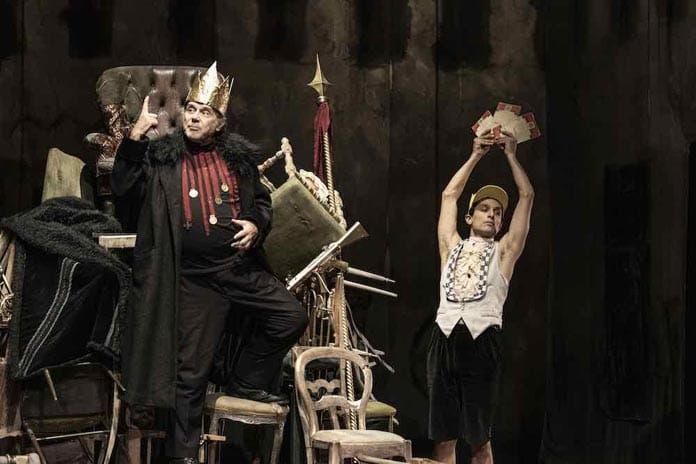
An enormous pile of stacked armchairs forms a baroque throne, at whose summit sits a violent, swaggering King Lear (Elio De Capitani). The walls on either side, like tapestries suspended in mid-air, depict swords with skull-shaped hilts. They are symbols of arrogance, aggression, and oppression, the thematic lens through which this new interpretation of the tragedy is constructed.
As it approaches the conclusion of celebrations marking fifty years of activity, Teatro Elfo Puccini presents a new Shakespeare, the ninth in the Milanese theatre’s artistic journey. In their director’s notes, Ferdinando Bruni and Francesco Frongia link the choice of King Lear to the awareness of having finally reached ‘the right age to take this journey’. From a technical and aesthetic standpoint, the production certainly bears witness to the artists’ maturity. Despite its three-hour duration, the performance proves to be a tightly engineered and fluid machine.
The construction of a perspectival stage, in which the side walls angle diagonally towards the centre, recalls the hierarchical vision of Renaissance theatres, where the ideal spectator seated at the centre of the auditorium was granted a privileged viewpoint. Yet it is precisely behind the walls that make up this structure that the intrigues threatening the kingdom’s hierarchical status quo take shape. Each time one of the tapestries rises, the pieces of the system’s inevitable collapse are revealed: from Lear’s descent into madness to Edmund’s plots, from love to betrayal and belated awakenings.
De Capitani’s Lear is an aggressive king who inspires fear in everyone around him. His gradual loss of lucidity, however, resembles less a true descent into madness than a regression into childhood. Capricious and spoilt, the ageing monarch adopts excessive, moody behaviours that verge on the infantile. He shouts, rants, and exasperates his interlocutors.
It is perhaps this vision of Lear as a petulant child that explains the occasionally cartoonish, caricatural acting of the characters who surround him. His elder daughters, Goneril (Elena Ghiaurov) and Regan (Elena Russo Arman), resemble Cinderella’s wicked stepsisters. Gloucester’s illegitimate son Edmund (Simone Tudda) appears as a comic-book villain, constantly grinning at the audience and breaking the fourth wall. An effeminate Oswald (Nicola Stravalaci) fills the scenes with broadly comic gags reminiscent of Italian Christmas comedies. The only true adult seems to be the Earl of Gloucester (Giancarlo Previati): reflective, measured, at times deeply moving, yet ultimately unable to escape the childish plots and power games of the play.
From this fairy-tale atmosphere emerges a particularly striking Fool (Mauro Lamantia). Dressed in a basketball vest, a tutu, and a cap shaped like a crown, he is an unmistakably contemporary fool, as if straight out of TikTok or Instagram. His enigmatic yet revealing pronouncements are peppered with ultra-modern forms of address such as ‘bro’ or ‘zi’. He is a ‘maranza’ fool, and perhaps the most compelling invention of this cartoon-like version of King Lear.
The performance concludes with a gesture that anchors it firmly in the present, almost taking the form of a call to action. As the characters retreat towards the back of the stage, Albany’s words are directed straight at the audience. Aware of the climate of war and oppression in which we live today, the ‘old kings’ on stage appeal to the responsibility of the young spectators: ‘The oldest hath borne most: we that are young shall never see so much, nor live so long.’